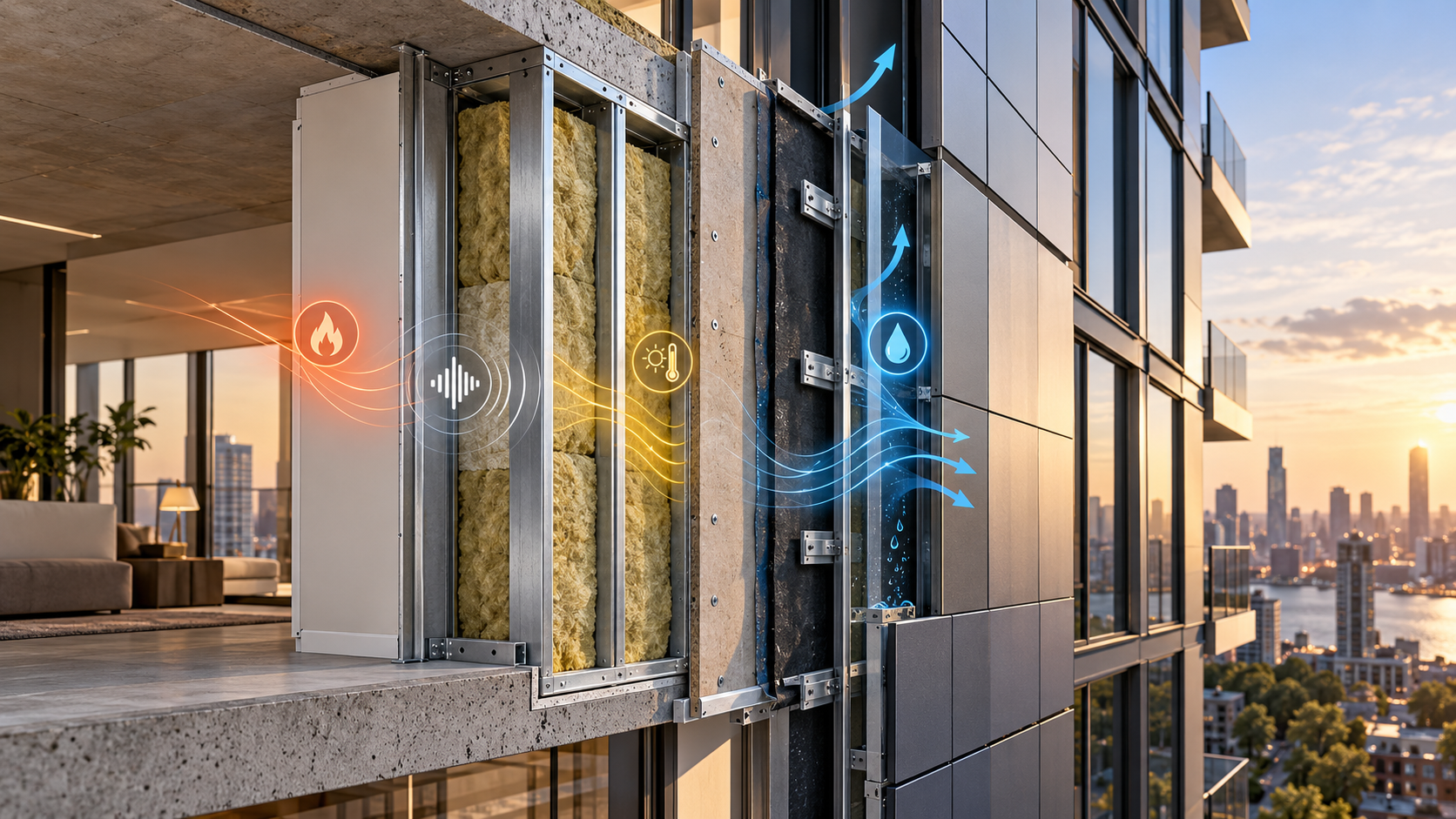
One good product does not automatically make one good wall.
Modern wall assemblies can include plasterboard, insulation, sheathing, framing, membranes, fixings, sealants and facade materials. Each component can arrive with its own technical documentation, but the finished wall still has to answer much bigger questions.
- Does it resist fire?
- Does it control heat loss?
- Does it reduce sound transmission?
- Does it manage moisture?
- Does it perform exactly as designed?
UK fire-safety guidance makes the point clearly: the performance of a material can depend on its orientation, substrate, fixings and the other materials around it.
A fire-rated product does not automatically create a fire-rated wall.
The industry is already changing.
A recent example comes from British Gypsum and Saint-Gobain. Their GypLyner Xternal through-wall system combines plasterboard and sheathing products with Isover stone-wool insulation and light-gauge steel framing.
Instead of treating each material as an isolated component, complete wall configurations have been tested together. Depending on the specified build-up, published systems achieve 60, 90 or 120 minutes of fire resistance, alongside acoustic performance reaching Rw 56 dB.
The important story is not the brand. It is the approach. The performance belongs to the complete construction.
That changes the conversation from “What fire rating does this board have?” to “What tested wall system can this board form part of?”
Insulation is no longer just about keeping buildings warm.
Thermal conductivity will always matter. But insulation is increasingly expected to contribute to several building-performance objectives at the same time: thermal efficiency, fire strategy, acoustic comfort, moisture management and continuity of the building envelope.
Stone wool is a good example because it can contribute to thermal, acoustic and fire-performance strategies. But the material cannot do everything by itself. A high-performance insulation product installed badly - or interrupted by poorly detailed junctions - may not deliver the performance expected from the finished building.
Plasterboard is becoming much more specialised.
Plasterboard has evolved far beyond a simple lining material. Today's market includes boards designed for fire resistance, moisture, acoustics, impact performance and external sheathing.
Within tested wall constructions, changing the type, thickness or number of boards can significantly change the performance of the entire system. Contractors increasingly need more than a board. They need the right board, in the right build-up, installed in the right way.
Regulation is moving in the same direction.
The UK government's construction-product reform programme points toward greater scrutiny of product suitability, testing, installation information and traceability. Industry responses to the reform consultation also showed strong support for looking more closely at complete systems, material compatibility and long-term performance.
That makes sense. Buildings do not fail one product at a time. They fail where materials, installation and design stop working together.
This changes the merchant conversation too.
For builders' merchants and distributors, price and availability will always matter. But increasingly, customers also need to know whether a material is right for the intended application, what construction it has been tested in, whether substitutions affect performance and whether the necessary technical documentation is available.
Merchants do not need to become architects or fire engineers. But clear, accurate technical information is becoming part of good materials supply.
Better systems could mean better buildings.
This shift should be positive for the building-materials industry. It rewards manufacturers that test products properly. It rewards clear technical documentation. It encourages better coordination between materials. And it gives responsible merchants and suppliers another way to compete beyond simply offering the lowest price.
For FENCYX, whose range includes plasterboard, cement board, insulation, plywood, structural OSB and roofing materials, the trend is especially relevant. Once those products reach a construction site, they rarely remain isolated materials. They become part of walls, floors, roofs and complete building envelopes.
The wall is becoming the product.
Construction is moving toward a simple but important idea: a board manufacturer sells boards, an insulation manufacturer sells insulation, and a framing company sells framing. But the building owner ultimately needs a wall that works.
That wall needs to manage fire, heat, sound, moisture and structural movement - potentially for decades.
The product matters. But the system decides the performance.