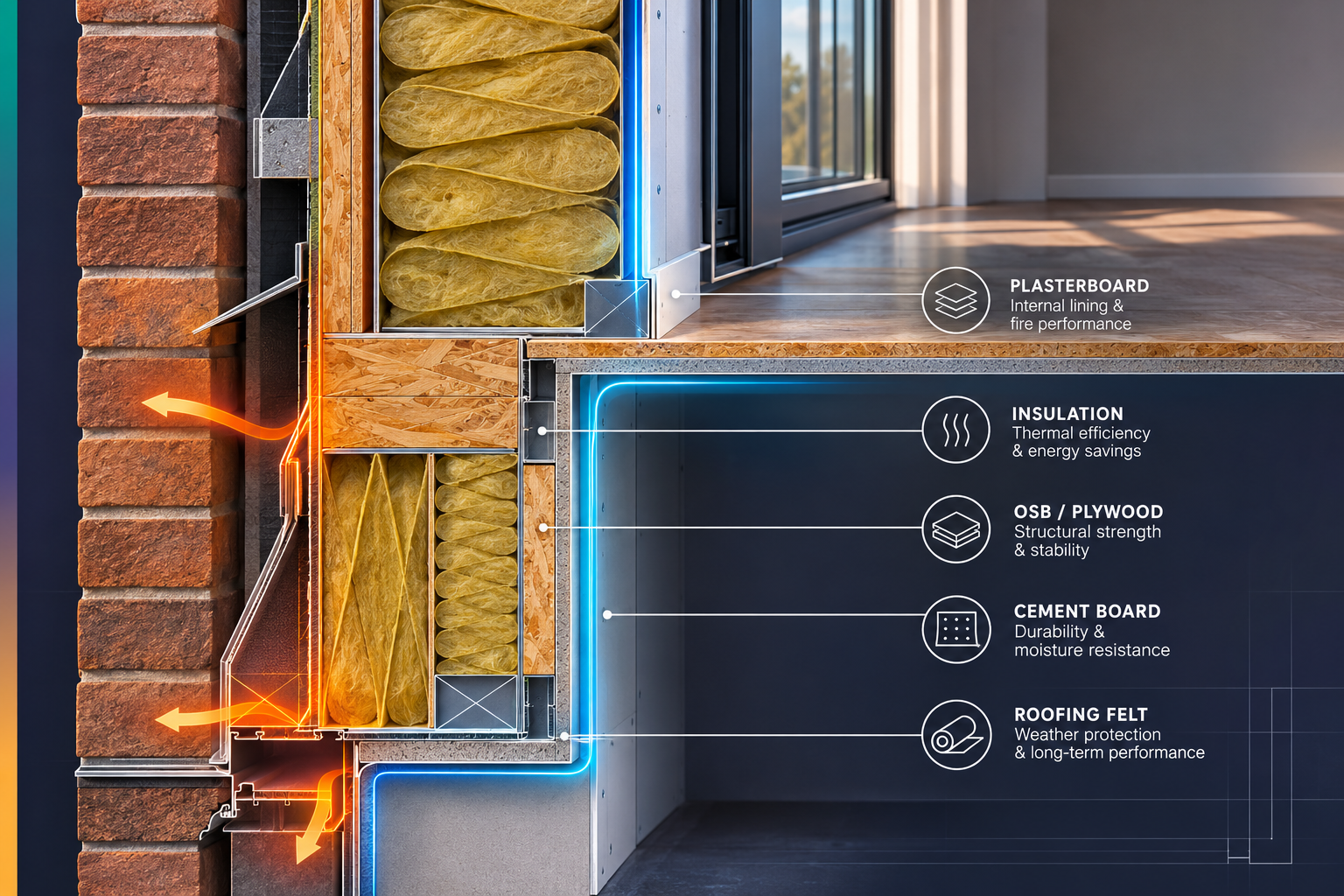
The weak points are often between the products.
Sometimes the most useful construction innovation is not a new material. It is learning how to use existing materials better. A building can contain excellent insulation, high-performance boards and carefully specified materials - and still lose heat where those materials meet.
On 2 November, the Structural Timber Association launched a free library containing more than 1,500 independently calculated thermal details and psi-values for common building junctions. The platform focuses on timber-frame construction, but the lesson behind it applies much more widely.
Better materials still need better detailing.
Building performance is not just about the centre of the wall.
When people think about energy efficiency, insulation thickness, thermal conductivity and U-value usually come first. Buildings also lose heat around floors, roofs, windows, doors, corners and structural connections.
These areas are thermal bridges. As the main parts of walls and roofs become better insulated, relatively small junctions become increasingly important. The new library helps designers estimate heat loss at these connections more accurately instead of relying only on broad default assumptions.
Insulation needs continuity.
A high-performance insulation product can have excellent laboratory values. But if the insulation layer is repeatedly interrupted around floors, roofs, openings or structural elements, the finished building may not perform as expected.
That does not mean the insulation is poor. It means the thermal envelope is incomplete. Better junction information can help architects, housebuilders and energy assessors reduce design risk, improve building performance and support more accurate compliance calculations.
For insulation suppliers, this shifts the conversation away from simply selling more insulation and toward making sure the insulation being specified is used effectively.
Boards are part of the performance story too.
FENCYX supplies several board categories, including standard, moisture-resistant, fire-resistant and specialist plasterboards, cement boards, hardwood-faced plywood and structural T-STRAND OSB.
These products perform different jobs. Some form internal linings. Some provide sheathing. Some contribute structural support. Others are selected for moisture resistance, durability or fire-performance strategies.
Increasingly, designers are looking at how those materials contribute to a complete wall or roof build-up. A sheathing board might influence airtightness detailing. OSB may form part of a structural wall system. Plasterboard may contribute to the internal lining and fire strategy. Cement board may be selected for a more demanding moisture or durability environment.
The product specification still matters. So does the junction where one product meets the next.
Roofing follows the same principle.
A roofing membrane can have an excellent technical specification. But the finished roof still depends on laps, penetrations, upstands, insulation continuity, edge details, drainage and workmanship.
Good materials create the potential for good performance. Good detailing turns that potential into a working building.
Construction is becoming more precise.
UK building standards are moving toward greater scrutiny of actual building performance, technical documentation and the gap between what was designed and what was eventually built.
Contractors and suppliers are increasingly being asked for more than a product and a price:
- clear specifications
- reliable technical data
- known dimensions
- appropriate applications
- consistent supply
- confidence that the material delivered matches the product designed into the building
That is good news for responsible suppliers. The more technically demanding construction becomes, the more valuable accurate product information becomes.
What this means for builders' merchants.
Customers will always ask how much a product costs and whether it is in stock. Increasingly, there is another question: is it right for this application?
A merchant does not need to become an architect or energy assessor. But being able to supply clearly specified materials - with reliable product data behind them - becomes more valuable as building designs become more performance-driven.
FENCYX's current UK range covers plasterboard, cement boards, insulation, roofing felt, hardwood-faced plywood and structural OSB, with product specifications and formats increasingly available online for merchant buyers. Better building performance ultimately depends on many product categories working together.
Better buildings start with better connections.
The new library of 1,500 thermal details will not transform UK construction overnight. Nor is it relevant only because timber-frame construction may grow. Its bigger value is the idea behind it: buildings are complicated assemblies.
Heat does not care which manufacturer supplied the insulation. Fire does not stop at the edge of a plasterboard sheet. Moisture does not respect the boundary between a board and a membrane.
Performance happens between products as much as within them.
Construction does not always need another new material. Sometimes it needs a better understanding of how the materials already available fit together.