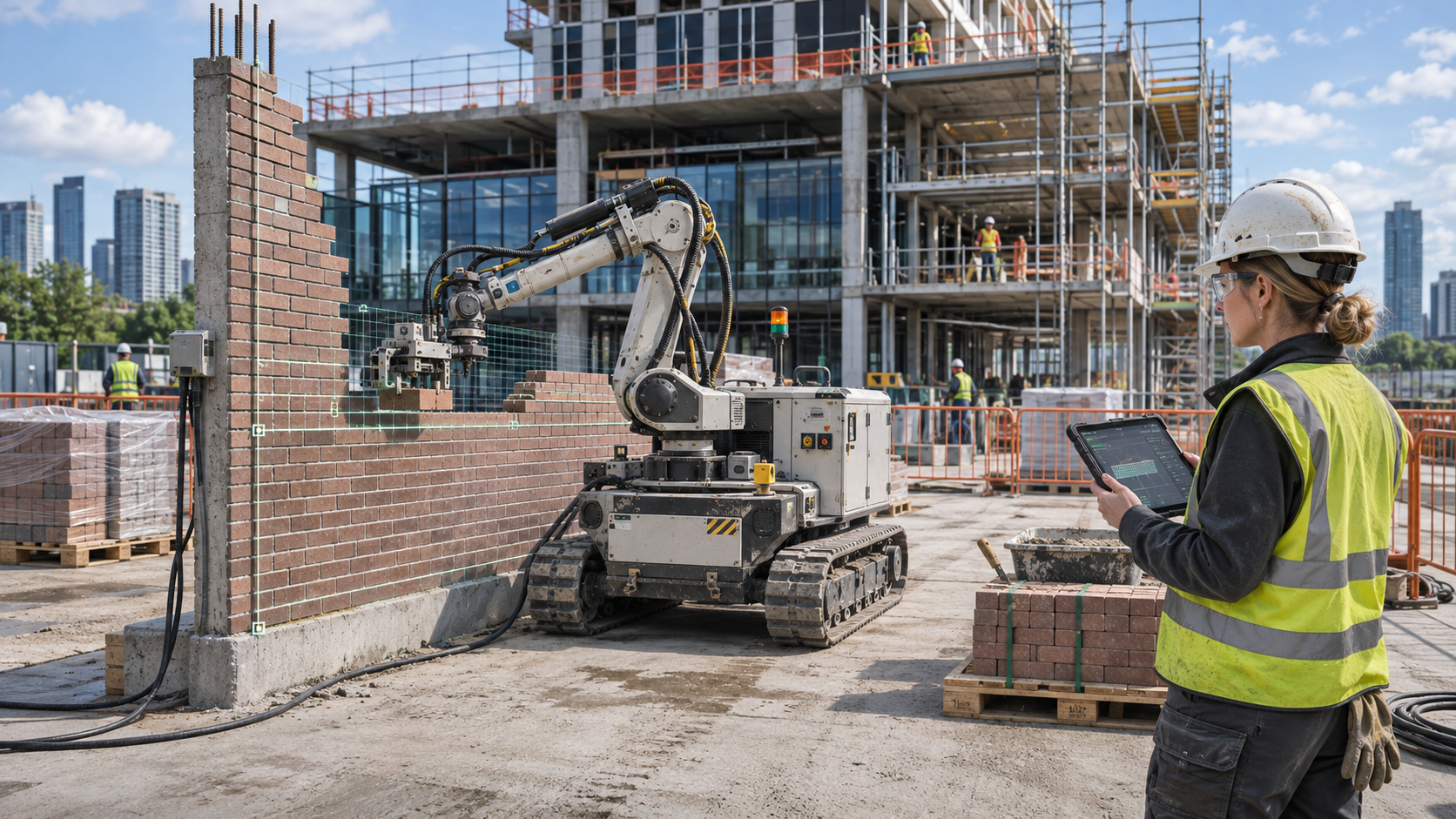
AI is becoming part of ordinary construction work.
For years, artificial intelligence in construction sounded like something that belonged in a presentation about the future: robots laying bricks, autonomous machinery and fully automated building sites.
That future may still come. But something less dramatic, and arguably more important, is already happening. New research from RICS published on 9 November suggests that around two-thirds of construction respondents now use AI somewhere in their work. Only 29% reported no AI use at all, while 37% said they plan to increase investment over the next 12 months.
Most of that use is practical. AI is helping teams check tender documents, collate submissions, create meeting notes and tag defects from site photographs.
Construction AI eventually becomes a materials story.
Every construction project eventually becomes physical. Software may design the building. BIM may coordinate it. AI may help plan it. But somebody still has to order the plasterboard, insulation, structural boards, steel, fixings, membranes and hundreds of other products required to build it.
Construction has always struggled with a difficult balance:
- Order too little material and the project stops.
- Order too much and money ends up in storage or eventually in a skip.
- Deliver too early and materials occupy valuable site space.
- Deliver too late and trades cannot work.
- Specify the wrong product and the consequences can ripple through the programme.
AI increasingly gives project teams another tool for managing those decisions.
One London project cut plasterboard waste by more than 20%.
On the L+G Headquarters project in London, digital construction platform KOPE was used alongside British Gypsum products to optimise plasterboard sizing across approximately 25,000 square metres of wall area.
The reported result was more than 20% less plasterboard waste, 4.8 tonnes of material avoided and 4.9 tonnes of embodied CO₂e avoided. The technology analysed different board configurations to find more efficient layouts before material reached the site.
Sometimes the greener solution is simple: use less material in the first place.
If software can calculate more efficient board dimensions, reduce offcuts and improve ordering accuracy, the benefit can appear simultaneously in cost, waste, transport and carbon.
AI could make material ordering much more precise.
Construction supply chains contain enormous amounts of information: drawings, material schedules, quotations, purchase orders, delivery dates, stock levels, programme changes, product substitutions and technical specifications.
Historically, much of that information has been interpreted manually. Research into AI in construction supply chains identifies applications ranging from demand forecasting and supplier selection to inventory management, logistics coordination and dynamic material ordering.
Instead of asking how much board a project might need next month, a contractor may increasingly be able to combine the model, programme, actual site progress and existing inventory to produce a more accurate answer.
- Fewer emergency orders.
- Less excess stock.
- Fewer unnecessary deliveries.
- Fewer delays caused by missing materials.
AI can also model what happens when a delivery goes wrong.
Procore and NVIDIA recently announced new digital-twin capabilities designed to combine project models, actual site information, procurement data and schedules. One proposed use is modelling how a late material delivery might affect downstream work and project milestones.
The technology is currently in closed beta, so it is not yet an everyday industry tool. But it shows where construction software is heading. A delayed shipment of boards does not only affect the boards. It can delay partitions, electrical work, ceilings, finishes and ultimately handover.
AI increasingly gives project teams the ability to see those consequences earlier rather than discovering them once the material fails to arrive.
Materials could become easier to specify too.
AI may influence construction materials even earlier, before anything has been ordered. Researchers at the University of Bath have developed an AI tool capable of estimating the embodied carbon of a proposed building from a simple written description.
The system can identify key materials including steel, concrete and timber and give designers early feedback on how changes to insulation, wall construction and glazing could alter embodied carbon. It remains a research tool rather than a replacement for detailed carbon assessment, but the direction is significant.
- Could a different wall build-up reduce carbon?
- Could a board dimension reduce waste?
- Could another structural system use less material?
- Could insulation performance improve without unnecessarily increasing thickness?
AI is beginning to watch the work as well.
Computer vision is increasingly being used to compare what has actually been installed against drawings and project programmes. The objective is not to remove the site manager or quality inspector. It is to catch problems earlier.
Finding an incorrectly installed component before the next layer covers it can be relatively straightforward. Finding it three weeks later can mean opening walls, removing material and doing the work again.
The cheapest material waste is often the rework that never happens.
Procurement is changing, but judgement still matters.
Constructing Excellence has examined AI use in construction procurement, including tender evaluation and bid preparation. The conclusion is not that machines should choose contractors or suppliers.
AI can remove repetitive work and improve consistency, but final decisions still require people who understand technical requirements, market conditions and whether what is being promised is actually deliverable. AI may also help smaller businesses organise technical information, prepare tenders and present their experience more effectively.
The construction-material supplier may also become a data supplier.
AI works best when the information behind it is structured and reliable. That means a future material supplier may compete not only on price, availability, quality and delivery, but also on:
- Technical data and dimensions.
- Certification and performance information.
- Pack quantities and stock visibility.
- Digital product information.
That is especially relevant to plasterboard, cement boards, insulation, roofing membranes, plywood and structural OSB, all part of the current FENCYX portfolio. A product sitting in a warehouse is useful. A product sitting in a warehouse with clear, machine-readable technical information, known availability and reliable logistics could become considerably more useful.
AI does not replace the construction supply chain.
It is easy to exaggerate what AI means for construction. The industry remains intensely physical. AI cannot unload a truck of plasterboard, install insulation correctly simply because the specification is correct or judge every unexpected condition on a live building site.
RICS stresses that professional judgement and human oversight remain essential as adoption increases. The opportunity is not replacing people. It is giving them better information earlier.
For construction-material manufacturers, wholesalers and builders' merchants, that means the materials remain physical, but the decisions surrounding those materials are becoming increasingly intelligent.