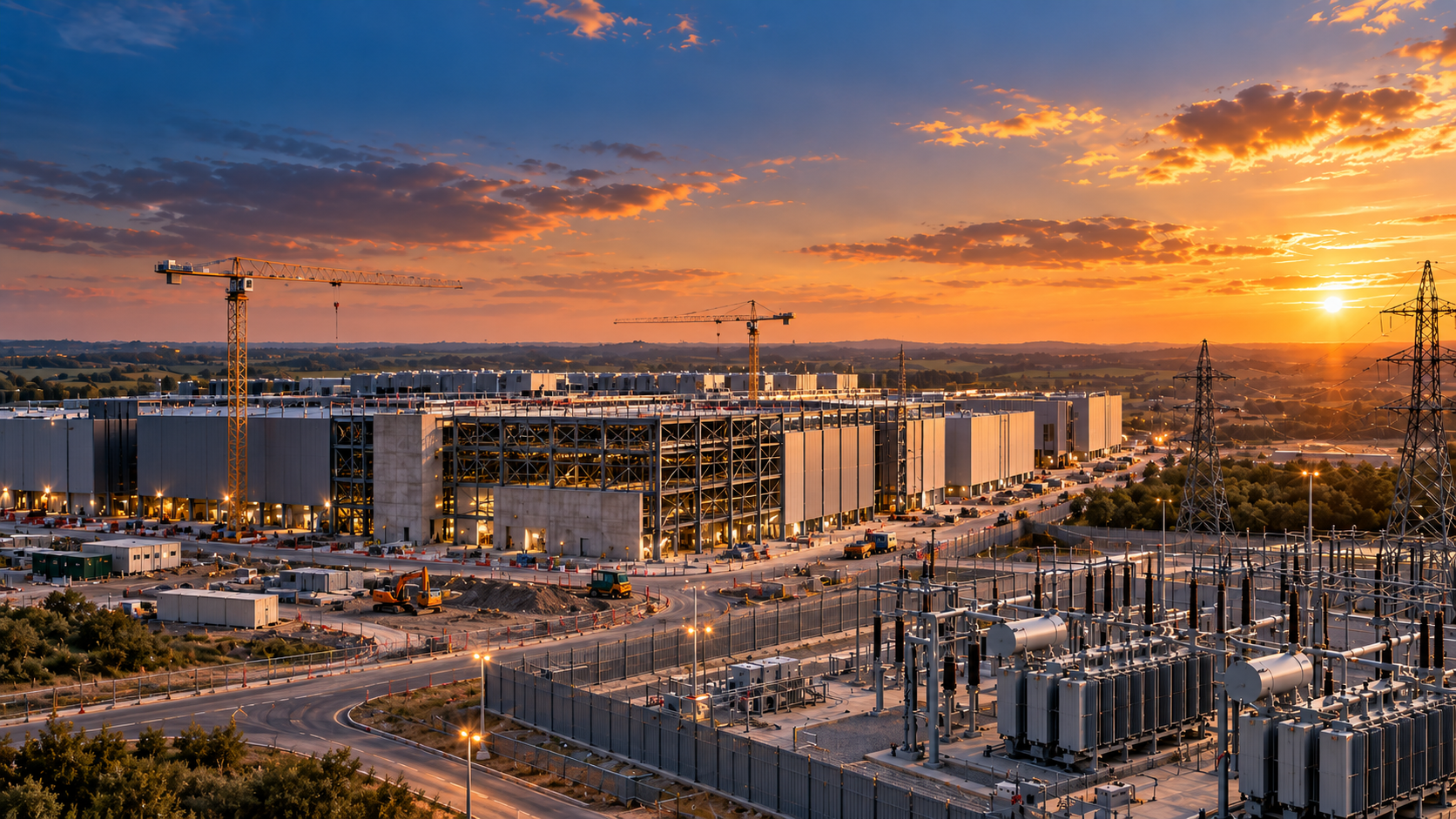
AI demand is becoming construction demand.
For most people, AI is experienced through a screen. Behind that interaction sits an increasingly large physical system: data halls, substations, transformers, cooling equipment, fibre networks, backup power, security systems and the buildings that contain them.
Turner & Townsend alinea reported in September, citing Barbour ABI, that more than £100 billion of data-centre construction is currently planned across the UK. That figure describes a development pipeline rather than £100 billion of contracts ready to start immediately, but its scale shows how rapidly digital infrastructure has entered the construction conversation.
The UK Government's Compute Roadmap forecasts at least 6GW of AI-capable data-centre capacity by 2030. For the construction industry, more computing capacity means more highly engineered places to house it.
More computing capacity requires more places to house it - and those facilities are among the most highly engineered buildings being delivered today.
A major project in Northumberland shows the scale.
The QTS data-centre development at Cambois, near Blyth in Northumberland, illustrates the regional impact. Northumberland County Council says the project represents potential investment of up to £10 billion and has planning permission for a campus of up to 540,000 square metres. The council expects around 1,200 construction jobs over several years, in addition to operational roles once the campus is complete.
The development also connects to underground high-capacity fibre infrastructure around the area. A large data-centre campus can therefore trigger demand for site preparation, roads, fibre, drainage, power connections, substations, specialist electrical works, cooling infrastructure and building materials.
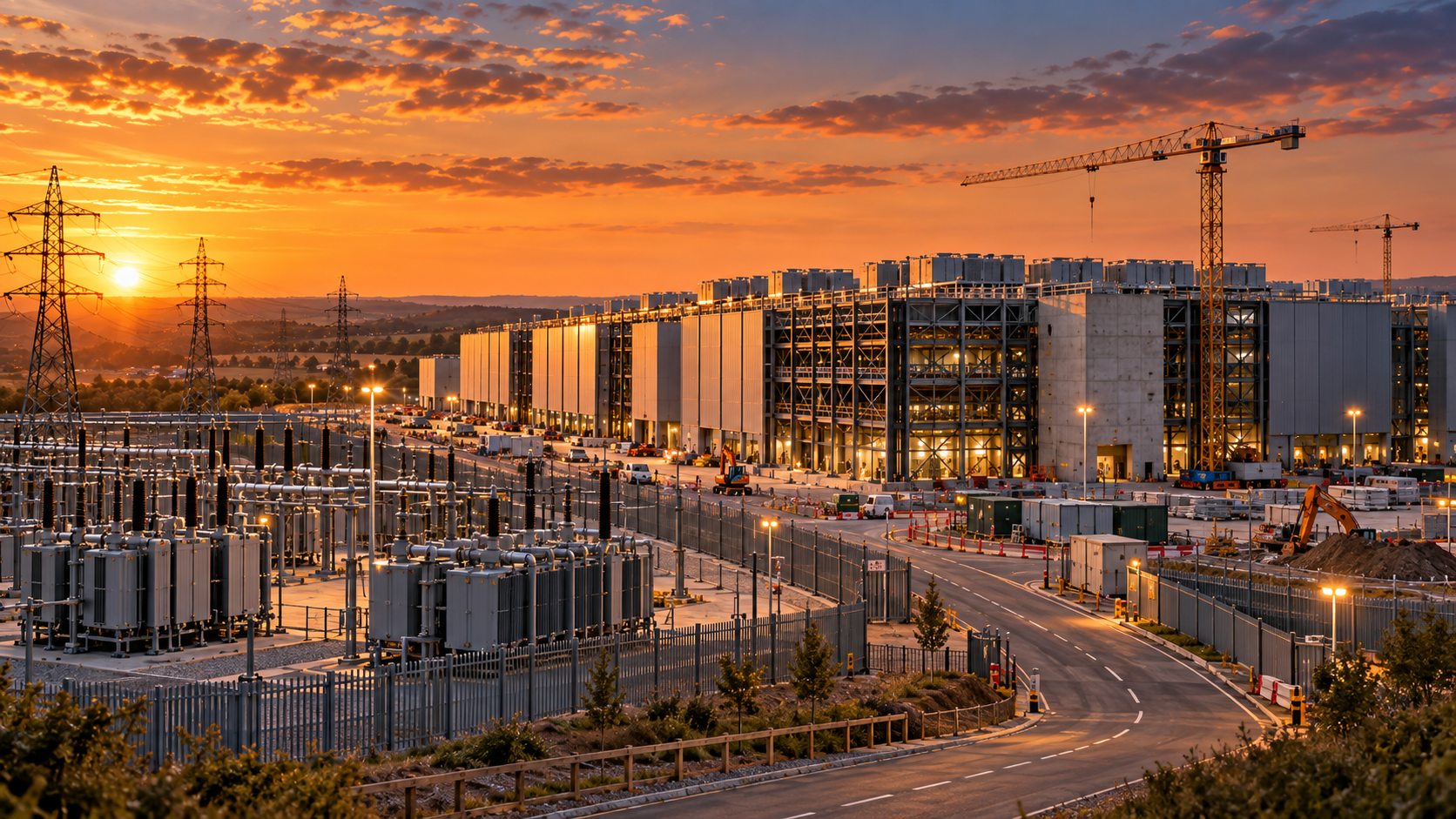
The grid is becoming part of the construction programme.
Power is one of the most important constraints and one of the largest infrastructure opportunities. Ofgem reported that applications for large demand connections had increased from 41GW to 125GW in less than a year, with data-centre projects accounting for at least 80GW of the queue.
That pressure is already translating into physical network investment. National Grid's North West London Upgrade includes a new substation, around 60km of new cable and more than 200km of upgraded overhead lines. The programme is intended to support five data centres among its new connections.
For contractors and suppliers, the opportunity extends across data-centre construction, utility work, civil engineering, transmission upgrades and the specialist systems that connect them.
What this means for construction materials.
AI data centres require structural systems, internal partitions, protected technical spaces, insulation, roofing, weather protection, fire-resistant assemblies, access roads, temporary works and supporting infrastructure. The opportunity is not to assume that every traditional building product automatically belongs in a data centre, but to understand where investment is moving and what specifications those projects require.
Data-centre projects place a premium on resilience, traceability, programme certainty and technical compliance. Suppliers that provide consistent specifications, dependable logistics and clear product information are well positioned to participate in a market where delays can be extremely costly.
Government statistics show UK construction material prices for all work were 5.9% higher year-on-year in July 2026. As new high-value construction sectors expand, procurement discipline and supply-chain resilience become even more important.
Technology is becoming physical infrastructure.
The wider construction market remains mixed. ONS estimates that total construction output fell 0.5% in the three months to July 2026, although output increased 0.1% in July itself. That makes new investment categories particularly significant.
Data centres will not replace housing, conventional infrastructure or commercial development. They add another large and technologically sophisticated source of construction demand connected to long-term investment in electricity networks, fibre, industrial facilities and regional development.
Not every project in the £100 billion-plus pipeline will be built. Grid access, planning, equipment lead times and project economics will determine which schemes move forward. But solving those constraints creates additional engineering and infrastructure work.
Artificial intelligence may live in the cloud. But the cloud has to be built somewhere.
FENCYX follows the forces changing demand across the UK construction-materials market, from traditional building activity to emerging categories such as digital infrastructure.